Top 100 Baby Names This Year


Expecting? Congratulations! 

The fun is only just beginning as you search for the best name for your new little sweetheart.

Some parents adore using popular names of the time; others desire a unique name of their own creation. But no matter which direction you go with a name, your beautiful little baby will soon fill your life with wonder and delight - and your heart will never again be the same.

Below are the 100 most popular names for babies born in the United States this year, based on the Social Security Administration's latest statistics.

Does your little one's name make the Top 100? We'd love to hear from you, see a snapshot of your cutie, and know what name you choose. Drop a comment below, or join in the conversation any time in any of these groups:


Most popular baby names of the past year for babies born in the United States.
RankMale nameFemale name
1LiamEmma
2NoahOlivia
3WilliamAva
4JamesIsabella
5OliverSophia
6BenjaminCharlotte
7ElijahMia
8LucasAmelia
9MasonHarper
10LoganEvelyn
11AlexanderAbigail
12EthanEmily
13JacobElizabeth
14MichaelMila
15DanielElla
16HenryAvery
17JacksonSofia
18SebastianCamila
19AidenAria
20MatthewScarlett
21SamuelVictoria
22DavidMadison
23JosephLuna
24CarterGrace
25OwenChloe
26WyattPenelope
27JohnLayla
28JackRiley
29LukeZoey
30JaydenNora
31DylanLily
32GraysonEleanor
33LeviHannah
34IsaacLillian
35GabrielAddison
36JulianAubrey
37MateoEllie
38AnthonyStella
39JaxonNatalie
40LincolnZoe
41JoshuaLeah
42ChristopherHazel
43AndrewViolet
44TheodoreAurora
45CalebSavannah
46RyanAudrey
47AsherBrooklyn
48NathanBella
49ThomasClaire
50LeoSkylar
51IsaiahLucy
52CharlesPaisley
53JosiahEverly
54HudsonAnna
55ChristianCaroline
56HunterNova
57ConnorGenesis
58EliEmilia
59EzraKennedy
60AaronSamantha
61LandonMaya
62AdrianWillow
63JonathanKinsley
64NolanNaomi
65JeremiahAaliyah
66EastonElena
67EliasSarah
68ColtonAriana
69CameronAllison
70CarsonGabriella
71RobertAlice
72AngelMadelyn
73MaverickCora
74NicholasRuby
75DominicEva
76JaxsonSerenity
77GreysonAutumn
78AdamAdeline
79IanHailey
80AustinGianna
81SantiagoValentina
82JordanIsla
83CooperEliana
84BraydenQuinn
85RomanNevaeh
86EvanIvy
87EzekielSadie
88XavierPiper
89JoseLydia
90JaceAlexa
91JamesonJosephine
92LeonardoEmery
93BrysonJulia
94AxelDelilah
95EverettArianna
96ParkerVivian
97KaydenKaylee
98MilesSophie
99SawyerBrielle
100JasonMadeline

The above data was compiled throughout the 12 months leading up to January 2019 by the Social Security Administration (babies born in the United States).


New Baby Visitor Guide for Friends & Family
Also available as oversized postcards for sharing with clients at Etsy.

It's a BOY?

Be sure to swing by IntactBaby.org/research and SavingSons.org for useful materials before your little one's arrival. Forced retraction is an epidemic in the United States today, and your sweetheart will be counting on you to keep him safe.
Foreskin Facts to be aware of before a baby boy's arrival.
Oversized postcards at Etsy for sharing with clients.
All babies arrive into the world intact - find intact care materials at DrMomma.org, SavingSons.org, or IntactHealth.org
Vinyl stickers for use on diapers, wipes, and baby's chart at Etsy.


Natural Foreskin Retraction in Intact Children and Teens

Guidance for healthcare providers by Doctors Opposing Circumcision and Medical Professionals for Genital Autonomy.


Photo by David Burnett

Introduction.

There is much uncertainty among health care workers about when the foreskin of a boy should become retractable.1 This has caused many false diagnoses of phimosis, followed by unnecessary circumcision, when, in fact, the foreskin is developmentally normal.

History. 

The first data on development of retractile foreskin were provided in 1949 by the famous British paediatrician, Douglas Gairdner. (2) His data have been incorporated into many textbooks and still is repeated in the medical literature today. Gairdner said that 80 percent of boys should have a retractable foreskin by the age of two years, and 90 percent of boys should have a retractable prepuce by the age of three years. (2) Unfortunately, Gairdner’s data are inaccurate, (3-4) so most healthcare providers have been taught inaccurate data. (4) Retractability usually occurs much later than previously believed. (3) This page provides accurate data, derived from newer and better studies, for healthcare providers.

Current View.

Almost all boys are born with the foreskin fused with the underlying glans penis. Most also have a narrow foreskin that cannot retract. Non-retractile foreskin is normal at birth and remains common until after puberty (age 18). Some boys develop retractile foreskin earlier, and about 2 percent of males have a non-retractile foreskin throughout life. Non-retractile foreskin is not a disease and does not require treatment.

There are three possible conditions that cause non-retractile foreskin:

  • Fusion of the foreskin with the glans penis
  • Tightness of the foreskin orifice
  • Frenulum breve (which is rare and cannot be diagnosed until the previous two reasons have been eliminated)

The first two reasons are normal in childhood and are not pathological in children. The third can be treated conservatively, retaining the foreskin.

Infants and pre-school. 

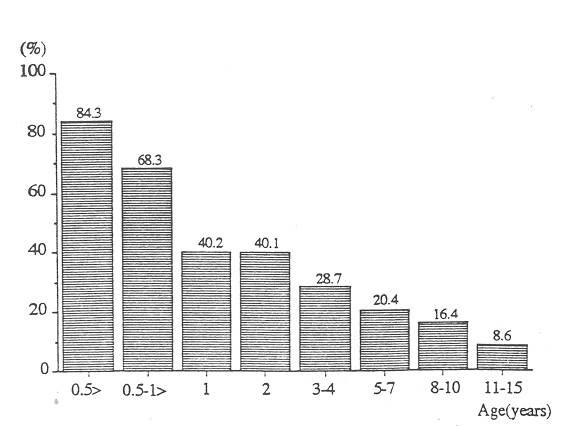
Kayaba et al. (1996) reported that before six months of age, no boy had a retractable prepuce; 16.5 percent of boys aged 3-4 had a fully retractable prepuce. (5) Imamura (1997) examined 4521 infants and young boys. He re-ported that the foreskin is retractile in 3 percent of infants aged one to three months, 19.9 percent of those aged ten to twelve months, and 38.4 percent of three-year-old boys. (6) Ishikawa & Kawakita (2004) reported no retractability at age one, (but increasing to 77 percent at age 11-15). (7) Non-retractile foreskin is the more common condition in this age group. Compare these data with Gairdner’s data!


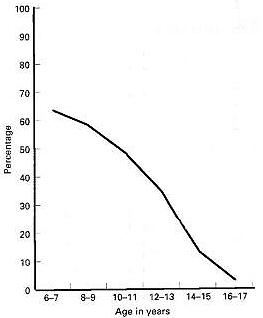
Øster graph
Percentage of boys with fused foreskin by age according to Øster

School-age and adolescence. 

Jakob Øster, a Danish physician who conducted school examinations, reported his findings on the examination of school-boys in Denmark, where circumcision is rare.8 Øster (1968) found that the incidence of fusion of the foreskin with the glans penis steadily declines with increasing age and foreskin retractability increases with age.8 Kayaba et al. (1996) also investigated the development of foreskin retraction in boys from age 0 to age 15.5 Kayaba et al. also reported increasing retractability with increasing age. Kayaba et al. reported that about only 42 percent of boys aged 8-10 have fully retractile foreskin, but the percentage increases to 62.9 percent in boys aged 11-15.5 Imamura (1997) reported that 77 percent of boys aged 11-15 had retractile foreskin. (6) Thorvaldsen & Meyhoff (2005) conducted a survey of 4000 young men in Denmark. (9) They report that the mean age of first foreskin retraction is 10.4 years in Denmark. (9) Non-retractile foreskin is the more common condition until about 10-11 years of age.

Kayaba graph
Percentage of boys with tight ring totally non-retractile foreskin according to Kayaba et al.

Discussion. 

Boys usually are born with a non-retractile foreskin. The foreskin gradually becomes retractable over a variable period of time ranging from birth to 18 years or more. (8,9) There is no “right” age for the foreskin to become retractable. Non-retractile foreskin does not threaten health in childhood and no intervention is necessary. Many boys only develop a retractable foreskin after puberty. Education of concerned parents usually is the only action required. (10)

Avoidance of premature retraction. 

Care-givers and healthcare providers must be careful to avoid premature retraction of the foreskin, which is contrary to medical recommendations, painful, traumatic, tears the attachment points (synechiae), may cause infection, is likely to generate medico-legal problems, and may cause paraphimosis, with the tight foreskin acting like a tourniquet. The first person to retract the boy’s foreskin should be the boy himself. (3)

Making the foreskin retractable. 

Occasionally a male reaches adulthood with a non-retractile foreskin. Some men with a non-retractile foreskin happily go through life and father children. Other men, however, may want to make their foreskin retractile.

The foreskin can be made retractable by:

  • Manual stretching (11-12) 
  • Application of topical steroid ointment (13-14)

Male circumcision is outmoded as a treatment for non-retractile foreskin, but it is still recommended by many urologists because of lack of adequate information, and perhaps because of the fees associated with circumcision. Nevertheless, circumcision should be avoided because of pain, trauma, cost, (15,16) complications, (15) difficult recovery, permanent injury to the appearance of the penis, loss of pleasurable erogenous sensation, (17) and impairment of erectile and ejaculatory functions. (18-20)

A website exists here where knowledable individuals give free advice to adults and teens on stretching one's foreskin to make it retractble.

References:
  1. Simpson ET, Barraclough P. The management of the paediatric foreskin. Aust Fam Physician 1998;27(5):381-3. [Full Text]
  2. Gairdner D. The fate of the foreskin: a study of circumcision. Br Med J 1949;2:1433-7. [Full Text]
  3. Wright JE. Further to the "Further Fate of the Foreskin." Med J Aust 1994;160:134-5. [Full Text]
  4. Hill G. Circumcision for phimosis and other medical indications in Western Australian boys. Med J Aust 2003;178(11):587. [Full Text]
  5. Kayaba H, Tamura H, Kitajima S, et al. Analysis of shape and retractability of the prepuce in 603 Japanese boys. J Urol 1996;156(5):1813-5. [Full Text]
  6. Imamura E. Phimosis of infants and young children in Japan. Acta Paediatr Jpn 1997;39(4):403-5. [Abstract]
  7. Ishikawa E, Kawakita M. [Preputial development in Japanese boys]. Hinyokika Kiyo 2004;50(5):305-8. [Abstract]
  8. Øster J. Further fate of the foreskin: incidence of preputial adhesions, phimosis, and smegma among Danish schoolboys. Arch Dis Child 1968;43:200-3. [Full Text]
  9. Thorvaldsen MA, Meyhoff H. Patologisk eller fysiologisk fimose? Ugeskr Læger 2005;167(17):1858-62. [Full Text]
  10. Spilsbury K, Semmens JB, Wisniewski ZS. et al. Circumcision for phimosis and other medical indications in Western Australian boys. Med J Aust 2003 178 (4):155-8. [Full Text]
  11. Dunn HP. Non-surgical management of phimosis. Aust N Z J Surg 1989;59(12):963. [Full Text]
  12. Beaugé M. The causes of adolescent phimosis. Br J Sex Med 1997; Sept/Oct: 26. [Full Text]
  13. Orsola A, Caffaratti J, Garat JM. Conservative treatment of phimosis in children using a topical steroid. Urology 2000;56(2):307-10. [Full Text]
  14. Ashfield JE, Nickel KR, Siemens DR, et al. Treatment of phimosis with topical steroids in 194 children. J Urol 2003;169(3):1106-8. [Abstract]
  15. Van Howe RS. Cost-effective treatment of phimosis. Pediatrics 1998; 102(4)/e43. [Full Text]
  16. Berdeu D, Sauze L, Ha-Vinh P. Blum-Boisgard C. Cost-effectiveness analysis of treatments for phimosis: a comparison of surgical and medicinal approaches and their economic effect. BJU Int2001;87(3):239-44. [Full Text]
  17. Williams N, Kapila L. Complications of circumcision. Brit J Surg 1993;80:1231-6. [Full Text]
  18. Denniston GC, Hill G. Circumcision in adults: effect on sexual function. Urology 2004;64(6);1267. [Full Text]
  19. Shen Z, Chen S, Zhu C, et al. [Erectile function evaluation after adult circumcision]. Zhonghua Nan Ke Xue 2004;10(1):18-9. [Abstract]
  20. Masood S, Patel HRH, Himpson RC, et al. Penile sensitivity and sexual satisfaction after circumcision: Are we informing men correctly? Urol Int 2005;75(1):62-5. [Full Text]

Related Reading on Intact Care: 


How to care for your son if he is retracting pre-puberty.
Foreskin Facts postcards available at Etsy

Breastfeeding Latch Trick

By Danelle Day, PhD © 2010


Preface: The information on this page is meant to help breastfeeding mothers who need latch assistance for their nursing baby. Photos and videos are for education and may not be suitable for all work environments.


Nipple Twist Latch Steps:

1) Pinch the areola right next to your nipple so the nipple can be moved (it may take a second for the nipple to evert if it was otherwise flat). You can use your thumb and first finger, or 2 fingers - whichever is easier for that side and the shape of your breasts. If you have 'puffy' breasts, you can also position the rest of your hand under your breast to lift it up slightly and away from your chest.

2) Turn the nipple up so it is pointing at your face. Do not be shocked if some milk exits. This is normal as you are putting very slight pressure on the milk ducts. There is no need to wipe off the milk as the scent will only help to encourage baby to nurse.

3) Position baby's mouth at the bottom of your upturned nipple, so baby's mouth is open over your nipple/finger and onto the above areola.

4) When you let go, the nipple will land deep into baby's mouth - where it is meant to be for comfortable latch and sucking.

Thank you to Bronwyn Millar for sharing her technique with DrMomma readers via video examples below. [Note: Millar's videos are not currently working due to online bullying of the Peaceful Parenting account and Google losses.]

Helpful items for breastfeeding mothers in the Breastfeeding Group: FB.com/groups/Breastfed.


How to compress the nipple upward to allow it to fall into baby's mouth for a good latch: 


Fetal Ejection Reflex


Meme by Christine Murray  

The fetal ejection reflex is real -- and it is amazing! Gloria Lemay writes in her excellent article, Pushing for First Time Moms:

Dr. Michel Odent [repeats] over and over, "Zee most important thing is: do NOT disturb zee birthing woman." We think we know what this means. The more births I attend, the more I realize how much I disturb the birthing woman. Disturbing often comes disguised in the form of "helping." Asking the mother questions, constant verbal coaching, side conversations in the room, clicking cameras—there are so many ways to draw the mother from her ancient brain trance (necessary for a smooth expulsion of the baby) into the present-time world (using the neocortex which interferes with smooth birth). This must be avoided. [...] Recognizing ways in which we can support the mother to enter that deep trance brain wave state that leads to smooth birth is imperative. I find it very helpful to have new language and concepts for explaining the process to practitioners. Dr. Odent has taught me to wait for the "fetus ejection reflex." This is a reflex like a sneeze. Once it is there you can't stop it, but if you don't have it, you can't force it. While waiting for the "fetus ejection reflex," I imagine the mother dilating to "eleven centimeters." This concept reminds me there may be dilation out of the reach of gloved fingers that we don't know about, but that some women have to do in order to begin the ejection of the baby. I also find it valuable to view birth as an "elimination process" like other elimination processes-coughing, pooping, peeing, crying and sweating. All are valuable (like giving birth is) for maintaining the health of the body. They all require removing the thinking mind and changing one's "state." My friend Leilah is fond of saying, "Birth is a no brainer." After all "elimination processes" are finished, we feel a lot better until the next time. Each individual is competent to handle her bodily elimination functions without a lot of input from others. Birth complications, especially in the first-time mother, are often the result of helpful tampering with something that simply needs time and privacy to unfold as intended.

The fetal ejection reflex is one that happens for most birthing women -- when they are fully safe, supported, and allowed to birth in peace. This, unfortunately, rarely happens in today's modern, North American birth world -- and is especially hard to come by in induction/pitocin-filled labor and delivery rooms. However, this primal state of birth still exists, and is waiting for us, as human mammals, to return to it: to make birth better, for babies and for mothers.

Related reading:

Pushing for First Time Moms: https://www.midwiferytoday.com/articles/pushing.asp

Do not disturb: The importance of privacy in labor: http://www.ncbi.nlm.nih.gov/pmc/articles/PMC1595201

What is the Fetal Ejection Reflex? http://www.spiritualbirth.net/what-is-the-fetus-ejection-reflex

Optimal Use of Language for Creating Birth Outcomes: http://wisewomanwayofbirth.com/optimal-use-of-language-for-creating-birth-outcomes

Birth from the baby's perspective: https://midwifethinking.com/2010/08/07/birth-from-the-babys-perspective

Excellent birth books: http://astore.amazon.com/peacefparent-20?_encoding=UTF8&node=3


10 Year Old with Autism Composes "I AM" - Wowing Teachers and Parents


As part of a multi-grade understudy, Benjamin Giroux was given a school assignment to compose a ballad. His specific project was to write the lyrics to a title of "I Am." The initial two words in each sentence were given, and it was up to Benjamin to write the rest. What resulted is a finished product that he poured his heart into.

Benjamin is a 10-year-old child from Plattsburgh, New York, who has been diagnosed with Asperger syndrome. He does not express much emotion with others, but was excited for this assignment. At work on the project at home, Benjamin's family said he didn't look up from his paper until he was finished.

When he showed his poem to his parents and his teacher, each adult was overwhelmed with emotion. 

Benjamin had always felt different because of autism, and at times said it made him stand out from the other children. Through his completed poem, the real, raw, reflection of living as himself comes through in a bold and beautiful way.

I Am

I am odd, I am new
I wonder if you are too
I hear voices in the air
I see you don’t, and that’s not fair
I want to not feel blue
I am odd, I am new
I pretend that you are too
I feel like a boy in outer space
I touch the stars and feel out of place
I worry what others might think
I cry when people laugh, it makes me shrink
I am odd, I am new
I understand now that so are you
I say I, “feel like a castaway”
I dream of a day that that’s okay
I try to fit in
I hope that someday I do
I am odd, I am new.

-Benjamin Giroux


Home Learning Resources and Things to Do During Coronavirus School Closing


Businesses are offering free subscriptions, and learning opportunities abound during this time of school closings during the coronavirus social distancing and quarantines. Below are some of the opportunities that have been shared with Peaceful Parenting. We will add more as they come in. Contact us any time at PeacefulParentingOrg(at)gmail.com

• Free Educational Resources during school closing: https://docs.google.com/spreadsheets/d/1NUKLZN7hGSu1Hzm70kfzBKs-lsSELaEMggS60Bi2O2I/htmlview?usp=embed_facebook&sle=true&pru=AAABcPe22BE%2AnPzlwaKU76E7xyX22h-7OA&fbclid=IwAR2ojtxrWhsWoPLgwLcPDHBh4YtCrAH_ecBhvXixTZGpgQULWgRxLBOvNzw

• Ideas to do at home with kids during social distancing: https://docs.google.com/document/d/1o6kEgCKLn3cyIm2hehhhSTIk7yRTd0C3zx49JS4wwCI/mobilebasic?fbclid=IwAR0BIKgzRwQXMgO-2TLbg0i6f8ZmM6A6Uo3iX7-wN9GUQ7IYVE9jRLiym_4

• Free, easy science for remote learning of all ages: https://mysteryscience.com/school-closure-planning?fbclid=IwAR2ET7f-60T_9ZLPMXz5LyNEDEd8uiFv3B52_mU81AHFWUABAqWqGDJQloU

• Using Purple Mash when School is Closed: https://2simple.com/blog/using-purple-mash-when-school-closed/

Intact Care & Circumcision Info Pack

In order to make a fully informed decision, having easy access to valid, research-based information is key. Working hand in hand with clinicians who volunteer with Saving Our Sons, we deliver accurate prepuce ('foreskin'), intact care, and circumcision information to any expecting parent or clients of intact conscious practitioners. There are 6 options below for getting material to your expecting friends and family members.

The Full Info Pack


The full SOS info pack includes:  
  • 80 pages of articles and research. This material broaches a wide range of sub-categories within intact literature, and responds to all major myths regarding the prepuce, intact care, and circumcision today. 
  • Complimentary videos on DVD full of helpful, research-based information on the prepuce, its care, and the circumcision decision parents in the U.S. and Canada are allowed to make today.
  • A proper intact care card and sticker for use at a physician's office, daycare, nursery or with a babysitter. We are happy to send along additional intact care cards or stickers at your request. These are 2-sided, full color, glossy, and made with heavy card stock so they can be reused (or laminated and kept handy with your baby's diaper bag). 
  • A National Medical Organizations Statements on Circumcision chart that highlights positions on infant circumcision from a variety of respected groups around the world including those in the U.S., Canada, U.K., Australia, Finland, India and others. 
  • A Keeping Future Sons Intact card especially for parents who may already have a son who was circumcised. This does not mean future sons cannot remain intact. Many families are raising both circumcised and intact sons, and we hope to support parents in this change of heart. 
  • A "Did You Know?" card full of quick facts about the prepuce, intact care, and circumcision in the U.S. and Canada. 
  • A "Babyface" postcard that contains quick facts on the prepuce, intact care, and circumcision, as well as a full list of websites by subject for doing additional research on the topics of circumcision, intact care, and restoration. 
  • An "Expecting a Boy?" postcard that contains quick go-to resources on the front; circumcision and intact care points on the back.
  • A "Trust His Body" postcard that serves as an encouragement to parents of the perfection with which their son arrives. The back has the functions of the foreskin and intact care information.
  • An "Intact vs. Circumcised Outcome Statistics" postcard that highlights the difference between an intact and circumcised newborn baby; shows a photo of what a circumcised infant looks like both from Plastibell and Gomco clamp, and lists statistics and risk factors both for keeping babies intact, and circumcising.
  • An "Intact vs. Circumcised Adult" postcard that specifies the way the glans must change from being an internal to external organ when circumcision is carried out. This card is also includes restoration information for men who may want to look further into this option. 
  • A "Lost/Found" card that has quick-facts on the functions of the foreskin on one side (things that are lost to circumcision) and the things found with restoration on the back. This card is especially for fathers who may feel their son should 'match' them.
  • A "Restoration" card that has go-to resources for men who may have been circumcised at birth, as well as the large variety of restoration devices available to men today. 
  • A "Breastfeeding/Circumcision" info card that points out the many ways that circumcision can hamper a successful breastfeeding relationship. 
  • A "Congratulations!" card with a wide variety of discussion groups on various topics parents may be interested in (everything from pregnancy, birth, breastfeeding, babywearing, cloth diapering, gentle discipline, raising girls or boys, etc.). 
  • An "Elephant in the Hospital" sticker. Dr. McAllister's entire Georgetown University lecture is included on the DVD with this pack; the sticker is added as an extra encouragement to spark interest and move parents to check things out. 
  • [Optional] Added faith-based information that is relevant to families who are devoutly Jewish, Christian, Muslim, Mormon, or Catholic. Please include a note when ordering or email SavingSons@gmail.com for faith-based items to be added. 
  • [Optional] An "HIV/AIDS and Circumcision" card stressing facts that relate to the 2006 HIV trials in Africa, and the myths that have surfaced from those trials in U.S. media. 
  • Calmoseptine samples: This ointment is the top recommended for use on developing skin. It does not interfere with a baby's natural pH or healthy (protective) microflora, and is perfect for use on babies during diaper days, when irritation or redness is common. It is the most recommended cream by pediatricians volunteering their time with Saving Our Sons, and is the cream we use when leading intact care classes. Calmoseptine can be purchased at most pharmacies around the world, or on Amazon. 
  • Contact information for Saving Our Sons and The INTACT Network volunteers, and follow-up with families who may have additional questions, or wish to talk with an intact friendly physician, educator, or other parents in their local area.
Each of the items in the SOS info pack has been specially selected by a board of individuals who have served in the professional fields of pediatrics, human sexuality, development, birth and education over the past 35 years. Our pack serves to empower parents in making a fully informed decision for their son before birth, and equipping parents with necessary resources for proper intact care after birth. The SOS info pack is perfect to share with friends, family and parents (or parents-to-be), as well as for birth and baby educators, midwives, doulas, and medical professionals to lend to expecting clients.

Information packs are $16 total (no profit is made on these items). $12 goes to printing, materials, and supplies; $4 to ship (U.S.), $7 (Canada), $8 shipping to other international locations by weight. If you donate more than $16, the remainder will go to help other families.

Be certain that your name and mailing address are correct when requesting via PayPal, or email SavingSons@gmail.com separately with mailing information.

If you are able to sponsor an info pack for another family, or help us attend the next maternity expo, please visit the sponsor page.


By Mail:

 Saving Our Sons
P.O. Box 1302
Virginia Beach, VA 23451
*include email so we can send shipping notice

Credit Card by Email:
SavingSons@gmail.com

On Etsy Here


Info Pack Replacement Sets
(for those lending the info pack to clients)


Especially for Educators & Birth Practitioners
Info Pack Replacement Sets
NOTE: Info packs have updated cards compared to those pictured above. New items will be included.
These are the cards normally included in the info pack,
(minus the Christian and Jewish themed cards which are only included upon request).
View each closely on the info cards page.
*International postage more by weight

To U.S. Addresses:
4 Sets = $8 (approximately 60-70 card/postcards total)
6 Sets = $11 (approximately 90-110 cards/postcards total)
10 Sets = $20 (approximately 150-170 cards/postcards total)
20 Sets = $40 (approximately 200-240 cards/postcards total)
REQUEST HERE

Credit card by email: SavingSons@gmail.com

Check by Mail:
Saving Our Sons
PO Box 1302
Virginia Beach, VA 23451

Expecting? Combo Pack


The Expecting? combo packet of informational items is significantly smaller than the full circumcision info pack (no DVDs or full articles), but is perfect for sending to any and all expecting friends/family. Materials are professionally made and serve to plant seeds of information on each of the following topics: circumcision, intact care, breastfeeding, babywearing and healthy baby sleep (i.e. no 'cry it out'). These items are mailed directly from Peaceful Parenting and include a thorough amount of material on circumcision and intact care, while at the same time covering other parenting topics that will impact a baby's life. 'Keeping future sons intact' themed info is included to ensure those who may already have circumcised boys find they have community and can be empowered to make a different decision the next time around. The Expecting? pack can be mailed anonymously - simply include an individual's name and address for shipping, or email SavingSons@gmail.com with this information. Indicate if you would like additional Christian, Jewish, Muslim, Mormon or Catholic items added to the pack.
$5 (materials/postage)

Via email for credit card to SavingSons@gmail.com

By Mail: 
Saving Our Sons
PO Box 1302
Virginia Beach, VA 23451

Don't Retract Info Packs

For clinicians may be requested here: SavingSons.org/2015/07/retracting-clinician-information-pack.html or by clicking the Don't Retract Pack tab at the top of this website.

Quick Request
($4 to cover materials/postage)
Include your physician's name/mailing address

Breastfeeding Mom's Pack


The Breastfeeding Mom's Info Pack was created to send to an expecting mother who plans to nurse her baby, in situations where you'd like to give her something to meet her needs, plant seeds of intact info, and encourage her in the gentle care of her baby on the way. 

These packs include:
  • 1 'peace love momma milk' bracelet (small or standard size)
  • 5 lanolin samples
  • $5 in Lansinoh coupons
  • 1 Calmoseptine sample
  • 1 'wean me gently' poem and natural weaning facts postcard
  • 2 'thank you for breastfeeding' cards
  • 1 Latch-On card
  • 1 'new parent?' card that specifically has links for those expecting boys
  • 1 feeding-on-cue (no 'cry it out') card
  • 1 breastfeeding/circumcision informational card
  • 1 breastfeeding mini journal, 'how big is a baby's stomach' chart, and helpful tips booklet
  • 1 Expecting a Boy? postcard with quick go-to links on the front and intact/circumcision care on the back
The bracelets are dearly loved by nursing moms everywhere and come in regular adult size, or small size for those with smaller wrists. The lanolin samples and coupons are heartily used and appreciated by new nursing moms. The poem is a favorite (read here) and the informational cards have been useful in leading mothers to more information for many years - saving countless babies along the way. You can view all cards in detail here. Materials/postage: $8


(for narrow/small wrists)

Wondering what breastfeeding has to do with circumcision? View this article with statements from LLLI: http://www.drmomma.org/2012/06/womanly-art-of-breastfeeding.html

Postcard by Mail

The Expecting a Boy? postcard (with care information on the reverse) and Babyface postcard (with quick facts and resources on the reverse) are sent in a blue envelope to your expecting friend/family member. Your friend will have our contact information for further questions/dialog, but this will be anonymous of who requested (unless you wish to be named, or include a note with the postcards). 

 
Be certain your friend's name/address is included in a note, or email SavingSons@gmail.com with this information.
$1+ donation to help cover postage.

Credit card by email: SavingSons@gmail.com 

By Mail:
Saving Our Sons
PO Box 1302
Virginia Beach, VA 23451

Email or Facebook

Information is almost always best received by professional materials in-hands. This sparks further curiosity in a way that leads people to investigate more deeply. The next best thing if you cannot get materials into someone's hands is to email or message them yourself with 1-2 quality links that lead to more information. The resource page at SOS is an effective starting point that has saved many babies: SavingSons.org/2014/12/should-i-circumcise-pros-and-cons-of.html It is also the landing page if you only share the SOS website (SavingSons.org). If you're unable or do not wish to email or message on Facebook yourself, email SavingSons@gmail.com and we will respectfully message your friend, anonymous of who requested.

We send one copy of the Expecting a Boy? postcard via email (pictured above), as well as 1-3 quality links that will lead the reader to further information, and are specific to that individual's family/faith/location. Saving Our Sons messages are professional, courteous, and we will get information to your friend/family member and answer any corresponding questions. We will not pester, harass or otherwise bombard your friend. 

Please include the following information when requesting that items be emailed/messaged: 
  • Name
  • Email or Facebook URL
  • Faith-based information (is this person Christian, Jewish, Muslim, Catholic, Mormon, etc.?)
  • Past child information (does this person already have a son who was circumcised?)
  • State or country that this individual lives in (so that we can connect them with a local leader/group for further dialog and connection if they wish) 


~~~~


I will not be working to get my body back

Photo by Alli Upham

No, no, you have it wrong, I will not be working to get my body back.
She was never lost.
She was here, giving every moment and detail to this sweet baby.
She was pushed and exhausted, stretched and stripped to make space for a new life.
Please stand back and aside.
For her sacrifice she will not be scrutinized.
She will be loved, and thanked and bowed down to.
She will be allowed her time to heal and be settled into.
This body’s work will not be forgotten, hidden or erased.
And if you feel it should, you understand nothing about the gift she has given.
No, no. Body don’t listen.
Because I see you.
I thank you deeply.
You did so good.

By Mia Car, Snuggle Me Organic

*******

Pregnant Moms Due This Year (more mainstream)

Birthing (more holistic)


Microbiome of Home Birth is Safer than Hospital Birth for Babies

Myth: Hospitals are cleaner.
Fact: The microbiome of your home is safer than hospital microbes.
Photo by Aimee Preston for Home Birth Aotearoa, New Zealand

By Home Birth Aotearoa

Let's talk about the microbiome!

We often hear about how dirty, untidy homes can be a hazard to babies -- and wouldn't you rather have a nice, clean hospital bed?

The reality is that sterility is not an ideal birth space, and that the bacteria that do survive in the hospital setting are dangerous.

Birth at home sets you and baby up for a diverse and robust microbiome.

Myth: Hospitals are cleaner.

Fact: The microbiome of your home is safer than hospital microbes. 


Dig into related reading on why this is the case:

Homebirth and the Microbiome: https://midwiferytoday.com/mt-articles/homebirth-and-the-microbiome/ 

Babies born at home have more diverse, beneficial bacteria:
https://www.sciencedaily.com/releases/2018/10/181031080557.htm 

Babies born at home have more diverse bacteria:
https://www.futurity.org/home-birth-diverse-microbiome-1901502-2/ 

Home birth may start babies off with health promoting microbes:
http://theconversation.com/home-birth-may-start-babies-off-with-health-promoting-microbes-119045

Rethinking Sterile: The Hospital Microbiome:
https://www.ncbi.nlm.nih.gov/pmc/articles/PMC4080534/ 

Rate of contamination of hospital privacy curtains on a burns and plastic surgery ward: a cross-sectional study: https://www.ncbi.nlm.nih.gov/pubmed/28413115 

Hospital Acquired Infections:
https://www.amboss.com/us/knowledge/Nosocomial_infections 

The most dangerous germs in the hospital may be those (people) bring with them:
https://www.sciencemag.org/news/2017/05/most-dangerous-germs-hospital-may-be-those-you-bring-you


Related Groups: 

Birthing (more holistic): FB.com/groups/Birthing

Pregnant Moms Due in [this year] (more mainstream): FB.com/groups/DueDateGroup

Peaceful Parenting Community: FB.com/groups/ExplorePeacefulParenting

Research Everything.
DrMomma.org


https://www.etsy.com/listing/589236581/new-baby-family-friends-visitor-guide?ref=shop_home_active_6&frs=1
New Baby Visitor Guide
Available for sharing with clients via Etsy.

LinkWithin

Related Posts with Thumbnails