
MCatLvrMom2A&X at Mothering
notes used with author's permission
Photos © 2010 Danelle Day, Ph.D. and Jennifer Quesada

The following information is to help answer some of the questions we see most often in regards to the normal separation of the prepuce (foreskin) from the glans (head) of the intact boy. In the course of the normal development of the intact penis some things might happen that may be alarming to those who have never been around an intact boy/man before. Many boys will have none of these things happen, and some will have one or more of them.
The following information has been compiled through many sources, along with personal experiences from myself and others.
When babies are born the prepuce is fused to the head of the penis much like the fingernail is to the nail bed. As a child grows, the process of separation starts (prepuce separating from the clitoris or penis glans). This process can start shortly after birth, or it may not be until the teenage years, and in some cases even into adulthood. (Some men and women go their entire lives without their prepuce (foreskin) retracting with no problems at all). There is no set age on when the foreskin will become or should be retractable just as they are is no set age when a girl will reach menarche. It appears that 2.5-3 years old is a time when a lot of the following separation questions arise. However, they can occur at any age.
The separation process in general does not happen all at once. It happens over a period of time from weeks to months, and in many cases even years. It can appear to happen overnight for some boys. The foreskin will often have spots that are still attached even after the rest of the foreskin has released from the glans. This is not cause for concern, when the time is right the spot will release just like the rest of the foreskin has. Unless trauma (such as forcible retraction) has occurred, in which case a skin bridge may form that may or may not need to be fixed. Generally, when the hormones of puberty hit, these attachments will release on their own. This can cause soreness in the spot that will usually resolve within 24-48 hours.
 healthy, intact penis of 2 year old
(prepuce has just started to open to begin separation process at the very end)
When the separation process starts there are some things you may, or may not see. These things include: ballooning, soreness, swelling and possibly some discharge.
Ballooning
Ballooning is a normal developmental stage and is not a cause for concern and does not require treatment, it is actually a sign that nature is doing it's job. Ballooning occurs when separation of the foreskin from the glans has started but the sphincter at the tip of the foreskin is still tight causing urine to pool under the foreskin. This is not harmful but it can be disconcerting to see it as the foreskin can balloon up quiet dramatically. It can last a short time or can come and go for months or years.
A child temporarily may report some discomfort or pain while urinating during this period. This occurs because the ballooning may tear at any residual connection to the glans. The discomfort will stop when separation is complete. The foreskin may still not be retractable at this point because the opening of the foreskin, sphincter, is still narrow. With increased growth and maturity, the ballooning will end when opening of the foreskin widens. See More: Ballooning
Pain, Swelling, Redness
Pain, swelling and redness can also go along with the ballooning or it can be seen without it. If either case 9 times out of 10 the pain and redness will resolve within 24-48 hours. If anything lasts longer than that the odds are higher that there is a infection present. It is important to note that if the problems last longer than the above mentioned time frame or you feel something is really wrong a trip to the Dr. is warranted since long term untreated infections can lead to scaring of the glans resulting in loss of sensation in those area's. Sometimes you may see small amounts of blood but it should not be much and it shouldn't last very long.
The most common infections are yeast or bacterial. The treatment for these is not at all difficult. Depending which is present treatment will either be anti fungal, OTC yeast medications like Monistat 7 day treatment (not the 3 day kind) and for bacterial infections OTC Bacitracin (a safer less reactive cream than Neosporin) can be used. Sometimes a prescription of oral antibiotics is required as well. If you do go the antibiotic route make sure to finish the whole prescription even if you son's penis looks healed in just a few days.
Neosporin is not recommended as some people react badly to it [and microflora is altered]. It is important to figure out if you are dealing with yeast or bacterial since the treatment for bacterial infection can make yeast worse. So a swab culture is essential to figure out exactly what you are dealing with.
If you do take your child to the doctor make sure that his foreskin is not pushed back on at all (See the Warning For Parents Of Intact Sons for more information as well as The Definition Of Retraction & Why it is BAD) If there is infection present this will make it easier to spread and cause more pain and trauma. To check to see exactly what pathogen is present a swab culture should be done. This is done with the long q-tip and a gentle rub of the very tip of the foreskin will pick anything up that is present without pushing on the foreskin at all.
Helpful tips for dealing with pain
Some things you can do to help if your son is in pain is letting him urinate in a cup of water or the bath tub this will dilute the urine so that wont sting. If your son is old enough you can tell him to retract just enough that the urinary opening is exposed so the urine doesn't go back under the foreskin. Long soaks in the bath with baking soda or a very small amount of Tea Tree Oil can also help sooth the pain.
[Editor's Update: If breastfeeding do not apply human milk to the genitals as this feeds yeast. Instead, opt for Calmoseptine which is an ointment that aids in healing without interfering with normal pH and healthy microflora. For more see: Yeast, Rash and Redness: Breastmilk feeds yeast, Neosporin alters microflora - what to do instead]. Diaper free time and stripping your diapers if you use cloth can be very helpful as well. Especially if dealing with yeast.
The things to watch for that would indicate more than separation injury is going on are: severe swelling that keeps getting worse, fever, discharge with a foul smell or dark green in color, unusual redness accompanied by any of the things mentioned above. If your son is having trouble urinating he needs immediate medical help.
The reason the foreskin reacts so strongly sometimes when separation is happening is because it is a very vascular organ and much like the lips even a small bump can cause swelling and pain.
The normal appearance of the glans and inner foreskin is usually a bright red/purple color. This is often disconcerting to parents who see it for the first time and they think that it is irritated, when in fact it is how it should look. The washed out color of the glans on a circumcised boy/man is caused from the drying out and keritinization of the skin caused by being exposed and rubbed against the clothing.
Smegma Pearl (Picture) Note: The penis in this picture is being partially retracted something that should NOT be done. The pearl is on the right side near the base of the glans it is the very large whitish area.
Something you may also see is called a smegma pearl. This is a whitish lump that can range in size from very tiny to pea size or larger. Smegma (the Greek word for soap) is a substance that consists of dead skin cells, body oil and other debris that clumps together forming a ball. It is not damaging and will work its way out once separation is sufficient for it to do so. It is not recommended that you try to massage it out or mess with it since this could cause tearing between the foreskin and the glans and result in pain and possible infection.
The time that smegma pearls are seen is when separation has started. It may make the glans under the foreskin appear like it is crooked. When touched it may feel hard but slightly squishy. It may also look like a blister under the foreskin. If there is any pain in that area odds are that it is being caused by separation and not the pearl, since Smegma is not a irritating substance in itself, unless there is a foreign body in there like lint, that can cause a bit of irritation. For the most part nothing will get under the foreskin but sometimes it happens, especially if separation is well underway.
You may also see a milky whitish discharge. This is smegma mixed with urine and is no cause for alarm. On occasion you may see a very large amount come out or it may just be a small amount.
Smegma can be the consistency of cottage cheese or it can be like liquid. It comes in many colors, pure white, yellowish, greenish, tan or a combination, it is often confused with pus. But the main thing between pus and smegma is that pus will have a really bad odor like an infection. While smegma may smell strong like unwashed genitals depending on how long it has been under the foreskin but not have a odor you would associate with sickness.
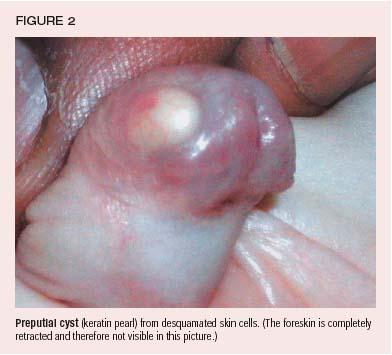
Preputial Cyst (Picture) Note: The penis in this picture is fully retracted something that should NOT be done.
There is also something called a Preputial Cyst that occurs on occasion. Sometimes known as a Keratin Pearl caused by dead skin cells accumulating under the top layer of skin on the glans. The appearance of swelling may occur sporadically as preputial cysts break through adhesions (push up against them) to allow separation of the prepuce, foreskin, from the glans. These whitish cysts are sometimes mistaken for pus due to infection, but they merely represent sterile collections of dead skin. It is a lot like a Smegma pearl but is not between the glans and foreskin but under the skin of the glans. In either case nothing special needs to be done.
Foreskin was retracting now it is not? (From Dr. Paul Fliess)
Sometimes a previously retractable foreskin will become resistant to retraction for reasons that are unrelated to impending puberty. In these cases, the opening of the foreskin may look chapped and sting when your son urinates. This is not an indication for surgery any more than chapped lips. This is just the foreskin doing its job. If the foreskin were not there, the glans and urinary opening would be chapped instead. Chapping is most often caused by overly chlorinated swimming pools, harsh soap, bubble baths, or a diet that is too high in sugar, all of which destroy the natural balance of skin bacteria and should be avoided if chapping occurs. The foreskin becomes resistant to retraction until a natural and healthy bacterial balance is reestablished.
You can aid healing by having your son apply a little barrier cream or some ointment to the opening of the foreskin. Acidophilus culture (which can be purchased from a health food store) can be taken internally and also applied to the foreskin several times a day to assist healing, and should be given any time a child is taking antibiotics.
Spraying While Urinating
Some boys will spray at one time or another during the process of penile growth. If your son has entered a spraying phase, simply instruct him to retract his foreskin enough to expose the meatus when he urinates (if he can do so himself and without pain of course). This is a phase and won't last that long. But it might come and go several times during the separation process. There is no difference in the amount of spraying between intact or circumcised boys - this has much more to do with a child's aim and the development of his urethra than whether or not he is intact.
Hygiene
A question we see here a lot as well is if the toddler/child is retractable should the parent retract the foreskin to clean. The answer to this is no, if the boy is not old enough to do it himself then the penis should continue to be cleaned by washing like a finger from base to tip, outside only, with warm water (no soap). Once the boy is old enough to retract on his own foreskin, he can retract, rinse with pure water, and replace - do not use soap on the exposed glans of the penis as this can cause pain, irritation and/or infection.
Paraphimosis (very rare, but good information to have)
Once your son is retracting on his own (for some boys this will not occur until their teenage years) be sure to let your son know to replace the foreskin over the glans any time he has retracted, so that it does not become trapped behind the glans. If this happens, it is known as paraphimosis and needs immediate attention. There are a few simple things that work most of the time to get it back in the proper position.
(Actual medical pictures of reduction, genitals shown)
Here are two great article on reducing paraphimosis:
British Journal of Urology 1999
Circumstitions Paraphimosis
How the foreskin works animated pictures:
NOHARMM Anatomy & Functions
Circumstitions Functions & Mobility of the Foreskin
Related Reading:
Painful Urination During Prepuce Separation
Ballooning in the Intact Child
How to Care for Your Intact Son (resource list of articles)
Basic Care of an Intact Child
Q&A For Intact Men
Protect Your Intact Son
For more information on the prepuce, intact care and circumcision see resources on this page.
notes used with author's permission
Photos © 2010 Danelle Day, Ph.D. and Jennifer Quesada

The following information is to help answer some of the questions we see most often in regards to the normal separation of the prepuce (foreskin) from the glans (head) of the intact boy. In the course of the normal development of the intact penis some things might happen that may be alarming to those who have never been around an intact boy/man before. Many boys will have none of these things happen, and some will have one or more of them.
The following information has been compiled through many sources, along with personal experiences from myself and others.
When babies are born the prepuce is fused to the head of the penis much like the fingernail is to the nail bed. As a child grows, the process of separation starts (prepuce separating from the clitoris or penis glans). This process can start shortly after birth, or it may not be until the teenage years, and in some cases even into adulthood. (Some men and women go their entire lives without their prepuce (foreskin) retracting with no problems at all). There is no set age on when the foreskin will become or should be retractable just as they are is no set age when a girl will reach menarche. It appears that 2.5-3 years old is a time when a lot of the following separation questions arise. However, they can occur at any age.
The separation process in general does not happen all at once. It happens over a period of time from weeks to months, and in many cases even years. It can appear to happen overnight for some boys. The foreskin will often have spots that are still attached even after the rest of the foreskin has released from the glans. This is not cause for concern, when the time is right the spot will release just like the rest of the foreskin has. Unless trauma (such as forcible retraction) has occurred, in which case a skin bridge may form that may or may not need to be fixed. Generally, when the hormones of puberty hit, these attachments will release on their own. This can cause soreness in the spot that will usually resolve within 24-48 hours.

(prepuce has just started to open to begin separation process at the very end)
When the separation process starts there are some things you may, or may not see. These things include: ballooning, soreness, swelling and possibly some discharge.
Ballooning
Ballooning is a normal developmental stage and is not a cause for concern and does not require treatment, it is actually a sign that nature is doing it's job. Ballooning occurs when separation of the foreskin from the glans has started but the sphincter at the tip of the foreskin is still tight causing urine to pool under the foreskin. This is not harmful but it can be disconcerting to see it as the foreskin can balloon up quiet dramatically. It can last a short time or can come and go for months or years.
A child temporarily may report some discomfort or pain while urinating during this period. This occurs because the ballooning may tear at any residual connection to the glans. The discomfort will stop when separation is complete. The foreskin may still not be retractable at this point because the opening of the foreskin, sphincter, is still narrow. With increased growth and maturity, the ballooning will end when opening of the foreskin widens. See More: Ballooning
Pain, Swelling, Redness
Pain, swelling and redness can also go along with the ballooning or it can be seen without it. If either case 9 times out of 10 the pain and redness will resolve within 24-48 hours. If anything lasts longer than that the odds are higher that there is a infection present. It is important to note that if the problems last longer than the above mentioned time frame or you feel something is really wrong a trip to the Dr. is warranted since long term untreated infections can lead to scaring of the glans resulting in loss of sensation in those area's. Sometimes you may see small amounts of blood but it should not be much and it shouldn't last very long.
The most common infections are yeast or bacterial. The treatment for these is not at all difficult. Depending which is present treatment will either be anti fungal, OTC yeast medications like Monistat 7 day treatment (not the 3 day kind) and for bacterial infections OTC Bacitracin (a safer less reactive cream than Neosporin) can be used. Sometimes a prescription of oral antibiotics is required as well. If you do go the antibiotic route make sure to finish the whole prescription even if you son's penis looks healed in just a few days.
Neosporin is not recommended as some people react badly to it [and microflora is altered]. It is important to figure out if you are dealing with yeast or bacterial since the treatment for bacterial infection can make yeast worse. So a swab culture is essential to figure out exactly what you are dealing with.
If you do take your child to the doctor make sure that his foreskin is not pushed back on at all (See the Warning For Parents Of Intact Sons for more information as well as The Definition Of Retraction & Why it is BAD) If there is infection present this will make it easier to spread and cause more pain and trauma. To check to see exactly what pathogen is present a swab culture should be done. This is done with the long q-tip and a gentle rub of the very tip of the foreskin will pick anything up that is present without pushing on the foreskin at all.
Helpful tips for dealing with pain
Some things you can do to help if your son is in pain is letting him urinate in a cup of water or the bath tub this will dilute the urine so that wont sting. If your son is old enough you can tell him to retract just enough that the urinary opening is exposed so the urine doesn't go back under the foreskin. Long soaks in the bath with baking soda or a very small amount of Tea Tree Oil can also help sooth the pain.
[Editor's Update: If breastfeeding do not apply human milk to the genitals as this feeds yeast. Instead, opt for Calmoseptine which is an ointment that aids in healing without interfering with normal pH and healthy microflora. For more see: Yeast, Rash and Redness: Breastmilk feeds yeast, Neosporin alters microflora - what to do instead]. Diaper free time and stripping your diapers if you use cloth can be very helpful as well. Especially if dealing with yeast.
The things to watch for that would indicate more than separation injury is going on are: severe swelling that keeps getting worse, fever, discharge with a foul smell or dark green in color, unusual redness accompanied by any of the things mentioned above. If your son is having trouble urinating he needs immediate medical help.
The reason the foreskin reacts so strongly sometimes when separation is happening is because it is a very vascular organ and much like the lips even a small bump can cause swelling and pain.
The normal appearance of the glans and inner foreskin is usually a bright red/purple color. This is often disconcerting to parents who see it for the first time and they think that it is irritated, when in fact it is how it should look. The washed out color of the glans on a circumcised boy/man is caused from the drying out and keritinization of the skin caused by being exposed and rubbed against the clothing.
Smegma Pearl (Picture) Note: The penis in this picture is being partially retracted something that should NOT be done. The pearl is on the right side near the base of the glans it is the very large whitish area.
Something you may also see is called a smegma pearl. This is a whitish lump that can range in size from very tiny to pea size or larger. Smegma (the Greek word for soap) is a substance that consists of dead skin cells, body oil and other debris that clumps together forming a ball. It is not damaging and will work its way out once separation is sufficient for it to do so. It is not recommended that you try to massage it out or mess with it since this could cause tearing between the foreskin and the glans and result in pain and possible infection.
The time that smegma pearls are seen is when separation has started. It may make the glans under the foreskin appear like it is crooked. When touched it may feel hard but slightly squishy. It may also look like a blister under the foreskin. If there is any pain in that area odds are that it is being caused by separation and not the pearl, since Smegma is not a irritating substance in itself, unless there is a foreign body in there like lint, that can cause a bit of irritation. For the most part nothing will get under the foreskin but sometimes it happens, especially if separation is well underway.
You may also see a milky whitish discharge. This is smegma mixed with urine and is no cause for alarm. On occasion you may see a very large amount come out or it may just be a small amount.
Smegma can be the consistency of cottage cheese or it can be like liquid. It comes in many colors, pure white, yellowish, greenish, tan or a combination, it is often confused with pus. But the main thing between pus and smegma is that pus will have a really bad odor like an infection. While smegma may smell strong like unwashed genitals depending on how long it has been under the foreskin but not have a odor you would associate with sickness.
Preputial Cyst (Picture) Note: The penis in this picture is fully retracted something that should NOT be done.
There is also something called a Preputial Cyst that occurs on occasion. Sometimes known as a Keratin Pearl caused by dead skin cells accumulating under the top layer of skin on the glans. The appearance of swelling may occur sporadically as preputial cysts break through adhesions (push up against them) to allow separation of the prepuce, foreskin, from the glans. These whitish cysts are sometimes mistaken for pus due to infection, but they merely represent sterile collections of dead skin. It is a lot like a Smegma pearl but is not between the glans and foreskin but under the skin of the glans. In either case nothing special needs to be done.
Foreskin was retracting now it is not? (From Dr. Paul Fliess)
Sometimes a previously retractable foreskin will become resistant to retraction for reasons that are unrelated to impending puberty. In these cases, the opening of the foreskin may look chapped and sting when your son urinates. This is not an indication for surgery any more than chapped lips. This is just the foreskin doing its job. If the foreskin were not there, the glans and urinary opening would be chapped instead. Chapping is most often caused by overly chlorinated swimming pools, harsh soap, bubble baths, or a diet that is too high in sugar, all of which destroy the natural balance of skin bacteria and should be avoided if chapping occurs. The foreskin becomes resistant to retraction until a natural and healthy bacterial balance is reestablished.
You can aid healing by having your son apply a little barrier cream or some ointment to the opening of the foreskin. Acidophilus culture (which can be purchased from a health food store) can be taken internally and also applied to the foreskin several times a day to assist healing, and should be given any time a child is taking antibiotics.
Spraying While Urinating
Some boys will spray at one time or another during the process of penile growth. If your son has entered a spraying phase, simply instruct him to retract his foreskin enough to expose the meatus when he urinates (if he can do so himself and without pain of course). This is a phase and won't last that long. But it might come and go several times during the separation process. There is no difference in the amount of spraying between intact or circumcised boys - this has much more to do with a child's aim and the development of his urethra than whether or not he is intact.
Hygiene
A question we see here a lot as well is if the toddler/child is retractable should the parent retract the foreskin to clean. The answer to this is no, if the boy is not old enough to do it himself then the penis should continue to be cleaned by washing like a finger from base to tip, outside only, with warm water (no soap). Once the boy is old enough to retract on his own foreskin, he can retract, rinse with pure water, and replace - do not use soap on the exposed glans of the penis as this can cause pain, irritation and/or infection.
Paraphimosis (very rare, but good information to have)
Once your son is retracting on his own (for some boys this will not occur until their teenage years) be sure to let your son know to replace the foreskin over the glans any time he has retracted, so that it does not become trapped behind the glans. If this happens, it is known as paraphimosis and needs immediate attention. There are a few simple things that work most of the time to get it back in the proper position.
(Actual medical pictures of reduction, genitals shown)
Here are two great article on reducing paraphimosis:
British Journal of Urology 1999
Circumstitions Paraphimosis
How the foreskin works animated pictures:
NOHARMM Anatomy & Functions
Circumstitions Functions & Mobility of the Foreskin
Related Reading:
Painful Urination During Prepuce Separation
Ballooning in the Intact Child
How to Care for Your Intact Son (resource list of articles)
Basic Care of an Intact Child
Q&A For Intact Men
Protect Your Intact Son
For more information on the prepuce, intact care and circumcision see resources on this page.


I think it would be helpful if you could put like a stats bar graph for each of these conditions, rate of occurence, treatement, what to avoid etc... I know it's explained in detail, but I just think if a bar graph was there, interested mothers and fathers can have a quick reference to look to.
ReplyDeleteMy Own Experience
ReplyDeletePersonally, I'm intact, and I come from a family of intact males. I can remember as far back as 3 years old, and I can remember when I couldn't retract my foreskin, when it was painful to even try, to the first time I saw my naked glans.
Never did I have ANY of these problems.
I remember that at 5, I had seen an older cousin retract his foreskin and I wanted to do the same. I remember that I couldn't, my skin was glued to the head of my penis, and it hurt to try and peel it back. I was jealous of him and I thought something was the matter with my penis. I told my mom this, and she told me I'd be able to do it when I was older.
So I forgot about my penis and my foreskin for a while. I just peed, fixed my erections whenever I got them, and went on with my daily life. I somehow had forgotten that I had a foreskin and that I wanted to retract it.
It's funny, because I remember playing with my foreskin, and now that I think about it, I didn't even realize I was doing it! When I would pee, I would purposefully hold the end of my foreskin shut, because I liked to see it balloon. I used to like the feeling of warm urine underneath my foreskin. When I grabbed it with the other hand, it felt like I had a bigger penis, and this felt nice. I can remember adhesions between my glans and my foreskin causing the balloon to be slightly sunk-in towards the middle, like a sudden dent where my skin would be sticking to my glans.
I'm telling you I did all of this and I had forgotten that at one point I wanted to be able to retract. I just thought that the way my penis was shaped, and the way it behaved, was just the way my penis was shaped and the way it behaved.
Until one day, for some strange reason I suddenly remembered. I had a flashback of my cousin's penis retracting to reveal a shiny purple head. At that instant, I went to the restroom. I must have been like 8 or 9. I ran to the restroom and locked the door, pulled my little guy out, and started tugging back. I instinctively expected to feel pain, so I went verrry slowly.
It surprisingly wasn't painful at all! Millimeter by glorious millimeter, my foreskin peeled back to reveal my purple, ultra sensitive and shiny glans. It didn't hurt to pull my foreskin back, but it did hurt to touch my glans directly. It was like touching an open wound. I still tried touching it, and it would hurt, especially because it started drying out, and when I touched it, my finger stuck to it, and it hurt to take it off. It felt like I was peeling velcro off of it every time I touched it. I instinctively knew I should spit on it and draw the foreskin back up before long.
My Own Experience, Cont’
ReplyDeleteLet me tell you, I walked out of that restroom a changed boy. I saw a part of me that I had never seen before. I loved to see that part of me. So much that I went back to the restroom time and time again, just to make sure I could still pull my foreskin back.
I got used to having my glans exposed, and even touching it. It's actually quite sensitive still today, but not so much that I can't touch it directly anymore. I still prefer to keep my foreskin over the head of my penis.
It was traumatizing for me to learn about circumcision. The more I learn about it, the more lucky I consider myself to be, and the more I love my normal, natural organ.
God, to think that a baby must undergo that, to live for the rest of his life like that. Forget the forceful tearing away of the foreskin and the crushing and cutting of it off; just to imagine to have my glans forever exposed like that, to dry out, to have it forever touch my clothing, and to forever have to peel things off of it... that a child must heal with the head of his penis dipped in urine and feces mixed together... the head of his penis is going to be covered in feces until he learns to use the toilet.
It just breaks my heart that this has to happen to babies. It terrifies me that I might have one day never had the experience I have described in this post today. That I would have been deprived of one of life's greatest joys, and of my natural organ for all of my life.
Everytime I see or read about circumcision I hold my organs in my hand and am on the virge of tears. Sometimes I wake up crying at night.
Circumcision.
What a shitty, shitty deal.
Thanks for this article! I'm glad to know this stuff. I have a son who's almost 2 years old, and although my husband is also intact (thanks be to my in-laws for that!) he does not remember when he became retractable or what it entailed, so I have to learn about this stuff on my own so I know what to expect for my son (or even the unlikely things that may happen in rare cases). It's good stuff to know for any parent of a little boy, I think.
ReplyDeleteI will say, I'm kind of afraid of what would happen if any of these rarely occurring things did happen to my son. Our pediatrician seems intact-friendly (advises parents against forced retraction, sees many intact patients since circ rates in this city are not but maybe 20%) but I also saw listed on our insurance website recently, that he performs circumcisions. :( I really am afraid that if one of these things happened to my son, our doctor would recommend cutting him, and my husband and I absolutely WILL NOT consent to that. We believe it is a human rights violation, and we know we are better than that. Even so, fighting with a doctor when all you want is what's best for your kid is not something any parent wants. How often DO doctors (right or wrong) recommend circumcision for this stuff?
Thanks for that very personal story, Joseph! So many people think circumcision is no big deal. I wish more people like you would share your stories online and let them know.
ReplyDeleteI am married to an intact man, and our son is intact.
ReplyDeleteMy husband has no memory of when his foreskin became retractable. He never really played with it until late in the teenage years, so it could have been at any time.
I believe my son is partially retractable. I've seen a flash of color when he was messing with it. He is currently 3.5 years old. Around the time I noticed that, he had a period of about 2 days when he was trying to avoid peeing by holding it as long as possible. I suspect he was a bit rough with himself and caused a little pain. But he seems fine now.
As a cut father of a 19-month-old intact boy, I want to thank you for this article. There's a lot I have no clue about, and this seriously taught me things I didn't even consider before. Bookmarked for future reference if anything goes awry (or seems to).
ReplyDeleteMy son never had any issues such as those mentioned above. He fully retracted after he entered puberty (age 11); before then, the skin was already coming back part-way. The initial full retraction was a little scary for him because I'd always impressed upon him the importance of not forcing it before it was ready; so I guess he was worried that it might hurt. Anyway, when the skin came back there was a layer of smegma that had to be washed away with water. He was told how to properly care for himself by daily washing (water only, no soap), and he has had no troubles at all.
ReplyDeleteHow about when they pee? An intact male told me that his urine would sometimes get stuck in his foreksin as a child before it was fully reatractable. So, he had to wipe after urinating...i never though boys really had to wipe circumcised or intact???????
ReplyDeleteAnd one more question...you only retract, rinse, and replace when fully retractable right? If it is 1/4 retractable, you don't follow those steps or do you?...like pull it down as far as it is retractable(so say that 1/4 ways) and do the steps?
I thought this poll (below) and the comments with it was great. It is very recent and as you can see the VAST majority of those with intact sons never face any 'issues' whatsoever. When you don't retract or try to clean the intact penis, you don't usually have to deal with any problems - ever! It is a wonderful self-cleaning, self-sustaining organ.
ReplyDeletehttp://www.mothering.com/community/forum/thread/1297365/one-more-poll-foreskin-non-issues
My son was 3 when a doctor forcibly retracted his foreskin. He screamed and then cried for days. He bled and bled. The doctor acted like the injury wasn't her fault and said he would probably need circumcision eventually because he was "so tight"... or maybe because she had just caused the need for it? Over the years, I've told every doctor since about the injury and asked for their opinion. Every doctor has said that my son's situation is "just fine." I assumed all was well in part because my son never complained. I also assumed that retraction has already occurred for him.
ReplyDeleteHowever, now, my son is 19 and cannot retract his foreskin. He's been to 3 doctors who are quick to offer circumcision. We cannot even find a urologist who will at least attempt less invasive measures (like stretching, steroid cream, or preputial plasty) first. One doctor said using steroid cream would make him infertile, so my son feels like he has to sacrifice his intact penis for the chance to be a father some day. He's lined up to see another urologist in 2 weeks. Unfortunately, my son is now willing to just get a circumcision if the next doctor recommends it. No doctor so far has mentioned anything about scarring on my son, and we aren't even sure whether he has scars. He has no pain, no issues with urination, he can get erections and masturbate... he just cannot retract his foreskin.
Does anyone know of a list of doctors who oppose circumcision in grown men... or who will only recommend circumcision as a true last resort? I am having a hard time trusting the doctors he has seen so far. They seem eager to schedule a circumcision and get paid. I will be happy to do what really needs to be done, but we just want to be sure we aren't getting bad advice.
dear anonymous! please contact
ReplyDeletehttp://www.doctorsopposingcircumcision.org/
and tell them your full story. do not circ yet. If everything is working fine with no pain then wait for their opinion and they could hook you up with a doc who's not pro circ.
Good luck and sorry to hear about what your son went through!
To the above poster...maybe try contacting some here: http://www.doctorsopposingcircumcision.org/about/contact.html
ReplyDeleteI'm so sorry for all your son has suffered. I hope you are able to find a non-surgical solution for his situation.
To anonymous poster from May 26, 2011,
ReplyDeleteI would strongly suggest you ask a pharmacist about the fertility thing as I did some looking and couldn't find any mention of this being a side effect of any steroid cream!!! As far as the stretching thing goes he can do that himself - check out this site http://www.cirp.org/library/treatment/phimosis/
and definitely look at "Beauge Method".
thank you! yesterday my 2yo's penis began swelling. i found your article in a google search, & it was just the thing. everything else on the net said INFECTION, ER, CIRCUMSISE.
ReplyDeletei gave him a bath, let him run about naked, & watched for the other signs. last night he had a bit of goo in his diaper, then again this morning. now his penis is nearly normal size, & i am feeling thankful for finding you. i was ready to rush him to the urgent care :)
thanks for the info!
My son is two turning 3, and I was told by specialist because he had a bad uti, to push back his foreskin, and have about 10 times (will not anymore now that Im more informed of problems it can cause him) but how do know if I have I injured or caused him more problems that can maybe be fixed well he's still young....I'm very sad I was missed informed by a specialist ....
ReplyDeleteSo sorry your specialist gave you such poor advice. This is not acceptable in today's age of information - where physicians should be as up to date as others on intact care. The best thing to do at this point is leave his prepuce (foreskin) alone and let the body heal - at the age of 3, he should be okay and damage is less likely than if he were 3 months old instead of 3 years old. Still, pushing the foreskin back actually increases chances of UTI (due to introduction of bacteria). So lots of warm water soaks in the tub, air-dry (undie/diaper free time) and skip the powders and chemicals as much as possible to reduce chance of repeat UTI. Calmpseptine is the best ointment to use if he does have irritation in the future (purchase from your local pharmacy and use on the outside of the penis/foreskin only).
DeleteHere is an article that may be of interest "Forced Retraction: Now What?" http://www.drmomma.org/2009/12/forced-retraction-what-now.html
This article has helped. My son is almost five and intact. It seems as though his father and I have been battling the doctors since his birth about circumcision. Every few months my son has "an episode" where it hurts to urinate and his penis swells. It appears that the hole at the top of his foreskin is getting smaller and makes it more difficult to urinate. Ballooning has been occurring lately. A Naturalist we spoke to recommended castor oil as a lubricant to help (and it has!) Every time this happens to him, his father and I discuss a circumcision. Then I read these articles and it reinforces our original choice, and makes us feel like we're NOT alone and we're doing the right thing by leaving the choice to him.
ReplyDeleteHi there I have a 2 year old is complaining of his penis hurting. He still wears diapers we took him to doctor and was told it's a minor irritation and to give warm bath no soap but he still complains any ideas .I'm just worried it could be an infection.any ideas?
ReplyDeleteThe best thing to get for irritation is Calmoseptine - www.Calmoseptine.com - request this from your local pharmacy. If they don't have it in stock, they can get it overnight. Any time there is redness or irritation, put this around the outside of the penis. It will soothe and help heal and reduce that discomfort during this time when the prepuce typically begins to separate from the glans (2-5 years is most common).
DeleteIm so glad I found this site/article! I just got back from the doctor's office with a referral to a urologist about my 23 month old's supposed phemosis. We had an incident this past weekend where there was some bleeding from the tip of my son's foreskin without any apparent pain or discomfort or signs of infection. It only happened once and has been fine since however I have noticed pink spots in his diapers from time to time (inconsistently, never 2 diaper changes in a row). Because the doctor couldnt retract his foreskin at all to examine his penis and determine the source of the bleeding he diagnosed him with Phemosis and sent us off with a referral. What Im wondering is if bleeding is possibly a normal sign of separation of the foreskin from the glans? Im going to see the specialist but I want to arm myself with as much information as possible as I feel adamant about avoiding circumcision and the use of hormonal creams to loosen the foreskin at so young an age. Any ideas?
ReplyDeleteErica - your question was reposted to the Saving Our Sons Facebook page so you can hear from more people on this: https://www.facebook.com/SavingOurSons/posts/583294978356294
DeleteAlso, it very well may be part of the separation process. Tiny drops of blood are not commonly seen for very long, but any part of the body can have this occur when things are moving, shifting, separating, tearing or becoming irritated. As you mentioned, he does not seem to be in pain, and this is not much or common, so best left alone. There is zero reason that your son should be retracting at 23 months of age.
Please see "The Phony Phimosis Diagnosis" http://www.drmomma.org/2010/01/phony-phimosis-diagnosis.html
And this article on normal retraction: http://www.drmomma.org/2008/04/natural-foreskin-retraction-in-intact.html
I'd also not let this doctor ever make attempts to retract again. :( That could be causing the issue in the first place.
Hi! My 35 month old son has been complaining off and on for the past 2 days that his penis hurts. I was really worried at first until I found your page and thought that he must be going through the separation process. Yesterday, when I changed his diaper I noticed a small piece of skin coming out of the opening of his penis. I gently looked at it and it was loosely just coming out so I picked it up and looked at it and it is definitely a small piece of skin. He was fine and didn't complain of any pain until tonight when he again complained of pain while peeing. I again found another tiny piece of skin near the opening of his penis, like it had come out of there again. Is this the skin that was connecting the glans to the foreskin coming out? Is it hurting him to pee because where the skin came unattached it is raw, until it heals? I am completely in the dark and had no idea about any of this until Friday night and my doctor has been closed all weekend. The outside of his penis looks normal, but he does complain that it hurts when he pees. Although he went all day today with no complaints.
ReplyDeleteVery glad I found this my husband and I could not pay for a circumcision and our family was worried but now I am happy we didn't get it done I now know what to look for and what to worry ab and what not to worry ab thank you
ReplyDeleteSo if child is 4yo and can pull back his own foreskin then okay to have him pull back and rinse when bathing or not really needed at such a young age? Read different things online. Also, if pulls back to rinse should he pull back to gently dry as well?
ReplyDeleteRinsing, retracting, etc. is not necessarily in any format in childhood. After puberty, your son can briefly rinse in the shower with warm water. However, until that time, the body does not produce much, if anything, in the genital area and other than splashing and playing in the bathtub, no other attention is needed for children. There is never a need (and it can be very irritating) to 'dry' the glans - it is meant to be a moist organ that maintains itself when left alone quite well. At age 4, let him play, take lots of warm water baths, and do nothing more. If you notice irritation or redness, you can get some Calmoseptine from your local pharmacy and put this around the outside of the penis/scrotum area. It will soothe and heal and take care of irritation quickly.
Delete