
By Danelle Frisbie © 2010
I was recently surprised to find that only 7% of women polled in OB/GYN clinics were aware that folate should be taken for 30-90 days before becoming pregnant. This same time frame holds true for healthy sperm production if you are trying to become pregnant. When a father-to-be stops smoking, limits or stops alcohol use, starts taking vitamins and eating right, exercising, and making other health-conscious choices, his sperm development and integrity are impacted as well. It is wise to implement these choices for both men and women at least 90 days before trying to conceive. This appears to be the best way to ensure healthy sperm, mature vial eggs, and an optimal conception and healthy pregnancy.
Having a healthy baby means making sure you are healthy, too. And one important thing you can do to help prevent serious birth defects in your baby is to get enough folic acid every day - especially before conception and during early pregnancy.
What Is Folic Acid?
Folic acid is the synthetic derivative of folate, a B vitamin (B9) found mostly in green leafy vegetables like kale and spinach, oranges, and enriched grains (some whole grain cereals). Repeated studies have shown that women who get 400 micrograms (0.4 milligrams) daily prior to conception and during early pregnancy reduce the risk that their baby will be born with a serious neural tube defect (a birth defect involving incomplete development of the brain and spinal cord) by up to 70%.
The most common neural tube defects are spina bifida (an incomplete closure of the spinal cord and spinal column), anencephaly (severe underdevelopment of the brain), and encephalocele (when brain tissue protrudes out to the skin from an abnormal opening in the skull). All of these defects occur during the first 28 days of pregnancy - usually before a woman even knows she's pregnant.
For this reason it is so important for all women of childbearing age to get enough folate - not just those who are planning to become pregnant - but anyone who may potentially become pregnant. Because only 50% of all pregnancies are planned, any woman who could become pregnant may want to fill her plate with green leafy veggies and snack on oranges on a regular basis.
Researchers still are not sure why folate has such a profound effect on the prevention of neural tube defects, but they do know that this vitamin is crucial in the development of DNA. As a result, folate plays a large role in cell growth and development, as well as tissue formation.
Getting Enough Folate
The U.S. Centers for Disease Control and Prevention (CDC) recommends that all women of childbearing age - and especially those who are planning a pregnancy - consume about 400 micrograms (0.4 milligrams) of folate every day. Adequate folate intake is especially important 30 days before conception and at least 90 days after to reduce the potential risk of having a baby with a neural tube defect.
So, how can you make sure you're getting enough folate?
In 1998, the Food and Drug Administration mandated that folate be added to enriched grain products - so you can boost your intake by looking for breakfast cereals, breads, pastas, and rice containing 100% of the recommended daily folate allowance. For many women, however, the fortified foods in their diet isn't enough. To reach the recommended daily level, you may want a vitamin supplement (folic acid).
During pregnancy, you require more of all of the essential nutrients than you did before you became pregnant - after all, you're growing another human! This does not mean you need double the calories, but you do need more nutrients and minerals. The best advice I've heard is to "eat to taste" - i.e. listen to what your body (and your baby) is telling you it needs. And then make smart choices to meet these needs.
Use the natural sugars in fruits or honey or pure maple syrup or milled flax, to satisfy cravings for sweets. Use seasoned vegetables and salt to taste when you are craving something salty. Try a locally-made, Stonyfeild, or other organic brand of natural yogurt or ice cream when you need something smooth and creamy. Munch on nuts and seeds and raw vegetables and fruits when you need the 'crunch'.
Prenatal vitamins should not replace a well-balanced diet - we get far more benefits from consuming whole foods in their natural forms, with their nutrient-rich vitamins and minerals, than we do from manufactured vitamins. However, taking prenatal vitamins can give your body - and, therefore, your baby - a cushion of protection of these essentials in case any are lacking from the foods you consume. Many health care providers now recommend taking a folic acid supplement in addition to your regular prenatal vitamin. Even if there are days (post-conception) where 'morning sickness' gets the best of you and the prenatal vitamins are too much to handle, a folic acid supplement is easier to pop. There is typically no problem in taking a prenatal vitamin every other day, or even every 3 days, with a folic acid supplement on the days in between.
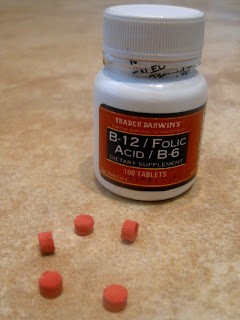
One of the best folic acid supplements I've found for women who suffer with morning sickness (or anyone interested in an 'easy' folic acid tablet) is Trader Joe's dissolving B6/B12/Folic Acid, pictured above. These are tiny little tablets that dissolve quickly and effortlessly in your mouth. No swallowing necessary. Ubber quick, easy, and 'painless' - even on those days when your stomach tells you otherwise. If you have a Trader Joe's near you, check them out. Or, have a friend mail you a bottle - they are worth the $1.30 in postage and one small bottle contains enough for your first 100 days. Other whole foods and health stores likely offer a similar product - ask at Whole Foods, Heritage (VA Beach), Roots (Cedar Falls), or your local health supply vendor.
In addition to folate, research suggests that consuming adequate amounts of omega-3 (an essential fatty acid) is important to optimal pregnancy health and the development of baby (especially his brain!). While you are shopping around, grab a bottle of organic krill or fish oil capsules, or similar product, and some organic milled flax seed (to throw in and on everything you cook). Implement these items into your daily routine as well -- both before and after conception -- to ensure you are getting the omega-3 you and baby needs.
Note: Two recent meta-analysises related to the levels of Vitamin A in cod liver oil suggest that this particular form of omega-3 is not ideal (as I have been in the habit of recommending and taking daily myself). This is still up for debate among nutritionists. Dr. Mercola discusses his revised recommendation here.
For additional information on measures you can take before pregnancy to ensure an optimally healthy conception, gestation, and baby, see Ogle's excellent book, Before Your Pregnancy: A 90 Day Guide for Couples on How to Prepare for a Healthy Conception.

I was recently surprised to find that only 7% of women polled in OB/GYN clinics were aware that folate should be taken for 30-90 days before becoming pregnant. This same time frame holds true for healthy sperm production if you are trying to become pregnant. When a father-to-be stops smoking, limits or stops alcohol use, starts taking vitamins and eating right, exercising, and making other health-conscious choices, his sperm development and integrity are impacted as well. It is wise to implement these choices for both men and women at least 90 days before trying to conceive. This appears to be the best way to ensure healthy sperm, mature vial eggs, and an optimal conception and healthy pregnancy.
Having a healthy baby means making sure you are healthy, too. And one important thing you can do to help prevent serious birth defects in your baby is to get enough folic acid every day - especially before conception and during early pregnancy.
What Is Folic Acid?
Folic acid is the synthetic derivative of folate, a B vitamin (B9) found mostly in green leafy vegetables like kale and spinach, oranges, and enriched grains (some whole grain cereals). Repeated studies have shown that women who get 400 micrograms (0.4 milligrams) daily prior to conception and during early pregnancy reduce the risk that their baby will be born with a serious neural tube defect (a birth defect involving incomplete development of the brain and spinal cord) by up to 70%.
The most common neural tube defects are spina bifida (an incomplete closure of the spinal cord and spinal column), anencephaly (severe underdevelopment of the brain), and encephalocele (when brain tissue protrudes out to the skin from an abnormal opening in the skull). All of these defects occur during the first 28 days of pregnancy - usually before a woman even knows she's pregnant.
For this reason it is so important for all women of childbearing age to get enough folate - not just those who are planning to become pregnant - but anyone who may potentially become pregnant. Because only 50% of all pregnancies are planned, any woman who could become pregnant may want to fill her plate with green leafy veggies and snack on oranges on a regular basis.
Researchers still are not sure why folate has such a profound effect on the prevention of neural tube defects, but they do know that this vitamin is crucial in the development of DNA. As a result, folate plays a large role in cell growth and development, as well as tissue formation.
Getting Enough Folate
The U.S. Centers for Disease Control and Prevention (CDC) recommends that all women of childbearing age - and especially those who are planning a pregnancy - consume about 400 micrograms (0.4 milligrams) of folate every day. Adequate folate intake is especially important 30 days before conception and at least 90 days after to reduce the potential risk of having a baby with a neural tube defect.
So, how can you make sure you're getting enough folate?
In 1998, the Food and Drug Administration mandated that folate be added to enriched grain products - so you can boost your intake by looking for breakfast cereals, breads, pastas, and rice containing 100% of the recommended daily folate allowance. For many women, however, the fortified foods in their diet isn't enough. To reach the recommended daily level, you may want a vitamin supplement (folic acid).
During pregnancy, you require more of all of the essential nutrients than you did before you became pregnant - after all, you're growing another human! This does not mean you need double the calories, but you do need more nutrients and minerals. The best advice I've heard is to "eat to taste" - i.e. listen to what your body (and your baby) is telling you it needs. And then make smart choices to meet these needs.
Use the natural sugars in fruits or honey or pure maple syrup or milled flax, to satisfy cravings for sweets. Use seasoned vegetables and salt to taste when you are craving something salty. Try a locally-made, Stonyfeild, or other organic brand of natural yogurt or ice cream when you need something smooth and creamy. Munch on nuts and seeds and raw vegetables and fruits when you need the 'crunch'.
Prenatal vitamins should not replace a well-balanced diet - we get far more benefits from consuming whole foods in their natural forms, with their nutrient-rich vitamins and minerals, than we do from manufactured vitamins. However, taking prenatal vitamins can give your body - and, therefore, your baby - a cushion of protection of these essentials in case any are lacking from the foods you consume. Many health care providers now recommend taking a folic acid supplement in addition to your regular prenatal vitamin. Even if there are days (post-conception) where 'morning sickness' gets the best of you and the prenatal vitamins are too much to handle, a folic acid supplement is easier to pop. There is typically no problem in taking a prenatal vitamin every other day, or even every 3 days, with a folic acid supplement on the days in between.
One of the best folic acid supplements I've found for women who suffer with morning sickness (or anyone interested in an 'easy' folic acid tablet) is Trader Joe's dissolving B6/B12/Folic Acid, pictured above. These are tiny little tablets that dissolve quickly and effortlessly in your mouth. No swallowing necessary. Ubber quick, easy, and 'painless' - even on those days when your stomach tells you otherwise. If you have a Trader Joe's near you, check them out. Or, have a friend mail you a bottle - they are worth the $1.30 in postage and one small bottle contains enough for your first 100 days. Other whole foods and health stores likely offer a similar product - ask at Whole Foods, Heritage (VA Beach), Roots (Cedar Falls), or your local health supply vendor.
In addition to folate, research suggests that consuming adequate amounts of omega-3 (an essential fatty acid) is important to optimal pregnancy health and the development of baby (especially his brain!). While you are shopping around, grab a bottle of organic krill or fish oil capsules, or similar product, and some organic milled flax seed (to throw in and on everything you cook). Implement these items into your daily routine as well -- both before and after conception -- to ensure you are getting the omega-3 you and baby needs.
Note: Two recent meta-analysises related to the levels of Vitamin A in cod liver oil suggest that this particular form of omega-3 is not ideal (as I have been in the habit of recommending and taking daily myself). This is still up for debate among nutritionists. Dr. Mercola discusses his revised recommendation here.
For additional information on measures you can take before pregnancy to ensure an optimally healthy conception, gestation, and baby, see Ogle's excellent book, Before Your Pregnancy: A 90 Day Guide for Couples on How to Prepare for a Healthy Conception.


I spoke to the nurse practitioner who I went to for GYN care and told her I was trying to conceive and that I had started taking a multi-vitamin and extra folic acid. She told me that she didn't think that was that important (meaning taking vitamins and folic acid before conception). Needless to say, I kept taking the vitamins. It's not just patients who need to be educated about nutrition before conception.
ReplyDeleteI have a pregnant friend who had severe morning sickness throughout the entire 1st trimester. I asked how she was keeping down her prenates and she said her Dr told her she didn't need to take prenates until the 2nd semester. I expressed my shock and concern that she wasn't taking folic acid but apparently her Dr said the baby didn't need it until she was about 15 weeks along! What a moron.
ReplyDeleteI'm not sure what type of doctor your friend was seeing, but many are not trained in nutrition science whatsoever (with the exception of 1 course in med school). And this training especially leaves out nutrition expertise for pregnant mothers and their growing babies. If there is any time that nutrients/minerals are essential, it is in the first trimester when all organs are being formed and started. The last trimester is also important as the brain goes into hyper development mode. When it comes down to it, the 40+/- weeks a woman is growing a baby, healthy eating and good nutrition are always important. But if you cannot take a vitamin, be sure to have a Luna Bar (all the vitamins of a prenatal are in 1 bar) and a folic acid supplement as well.
ReplyDeleteMost people don't realize the difference between folic acid and folate, since they're both 'the same vitamin.'
ReplyDeleteREAL folate is much better than folic acid.
Dr. Fuhrman warns:
DO NOT take multivitamins that contain folic acid and if you are pregnant, DO NOT take prenatal vitamins!
http://www.drfuhrman.com/library/folic_acid_dangers_and_prenatal_vitamins.aspx
Basically about 50% of the population doesn't process folic acid (which is synthetic B9) effectively. We require 5-methyltetrahydrofolate (5-MTHF) the natural form, or else we have a lot of diseases and disorders, such as
Downs syndrome, blood clots, cardiovascular disease, chronic fatigue, IBS, anxiety, fibromyalgia, depression, migraines, strokes, homocysteine, dementia, schizophrenia, nerve pain, Parkinson, miscarriage, infertility, Alzheimers, non-Hodkins lymphoma, gastric cancer, kidney failure, addiction, alcoholicsm, obesity, heavy metals, diabetes, Leiden Factor V, OCD, bipolar, aggression, liver dsyfunction, renal dysfunction, pulmorary fibrosis, autism, breast cancer, colorectal cancer, adenoma, endometrial cancer, lung cancer, spina bifida, neural tube defects, preeclampsia, placental abruption, hypothyroid, psoriasis, etc.
[there are nuances to the different types of folate, but bottom line, we must have sources of bio-available folate. ]
What foods provide folate?
Romaine lettuce, spinach, asparagus, turnip greens, mustard greens, liver, collard greens, broccoli, cauliflower, beets, lentils, squash, black beans, pinto beans, garbanzo beans, papaya, string beans...
Also, many medications interfere with the utilization of folate:
Medications that can help deplete the body's supply of folate include: anticancer drugs like methotrexate; cholesterol-lowering drugs; anti-inflammatory drugs like sulfasalazine; biguanide drugs like buformin, phenformin, or metformin used in the treatment of diabetes; birth control pills (oral contraceptives); diuretics like triamterene; and antibiotics. While the anti-convulsant drug phenytoin (sold under the brand name of Dilantin or Phenytek) remains somewhat controversial in terms of its impact on folate.
http://heal-thyself.ning.com/profiles/blogs/folate-vs-folic-acid
http://www.detoxpuzzle.com/mthfr.php
http://heal-thyself.ning.com/profiles/blogs/mthfr-1
Pat
Thank you! I knew I had read something about supplementing folic acid could be potentially negative!
DeleteI recently read an article that stated only the synthetic form (folic acid) is responsible for reducing neural tube defects. There isn't a lot of good definitive information out there. Taking the synthetic form doesn't seem to make a whole lot of sense to me but everyone is eager to do the best thing possible.
ReplyDeleteIf that really woud be the case, why didn´t those defects happen more often in earlier times of the human race?
DeleteHow did nature make such a fault and causes a regular vitamin defiency...doesn´t happen, does it?
It is not just the folic acid, requirements went from 200 to 400, than 600 and than 800.
You can gain 800mcgr with normal food if you eat enough leafy greens which our ancestors surely did.
But that also meant a big intake of other b vitamins and I think that makes the real difference. Not just folic acids, but a symbiosis of everything else
During my pregnancy I took Green Pastures fermented cod liver oil... they use a traditional Norwegian fermentation practices apparently! Norwegians used to leave a barrel of cod livers to ferment outside their doors. The smell is bad but you know you're getting the really good unrefined stuff LOL!
ReplyDelete